Case Study: The Impact Collective

Updated: Jul 31

My role: UX Researcher
Timeline: 3 months
Introduction
The Problem
More than 85% of social enterprises globally shut down within the first three years of operations, partly due to limited access to technical talent.
The Solution
Develop a platform that connects social enterprises with technical needs, with a burgeoning collective of students and professionals (tech talent) willing to fill those needs within an impact-focused and inclusive ecosystem.
Basic Context and Project Scope

Project Scope
The Impact Collective aims to create an ecosystem that connects nonprofits and social enterprises with industry professionals and graduate students.
My team and I were asked to validate the concept and understand the needs of prospective users, specifically graduate students, which will inform the platform design, user experience, and functionalities.
User Profile

Research Goals
The project had two major research goals:
Goal 1
To gauge the needs and interests of UC Berkeley graduate students to work with social impact organizations via a platform and identify the user persona.
Goal 2
To develop a list of needs which will inform the design and user experience of the platform.
The main research questions we sought to answer this semester were:
What does the ideal candidate for technical talent look like?
Do UC Berkeley graduate students want to work on social-impact focused projects?
What are the needs of UC Berkeley graduate students who want to work with social-impact organizations?
Do UC Berkeley graduate students want to use a platform like the one the Impact Collective is proposing? If so, what core features should this platform have?
Methods
I will review each method we selected including the reason why we choose each method.
Interviews | Surveys | Prototype Testing | |
Method |
|
|
|
Justification |
|
|
|
Method 1: Interviews
We conducted 5 in-depth interviews (~45 minutes each) with UC Berkeley graduate students. These were the main questions we asked (but kept the interviews semi-structured so we could probe interesting points):
What are your thoughts on a platform and community that lets you connect with social impact organizations with technical needs?
In general, when working with a client or for a school project, what are your key considerations in choosing what project to work on?
Can you describe how you would typically look for jobs or projects to work on?
How important is earning income while working on projects?
Key Findings
We created an affinity map to determine major themes from the interviews.

Key Finding #1
Getting paid is important.
5 out of 5 participants expressed the importance of compensation as an acknowledgement and a necessity towards the work they are doing
Earning an income is one of the main motivators
“It’s not about the money, but giving value to your work” - MDevEng student
Key Finding #2
Finding the right fit.
3 out of 5 participants want to find impactful work where and how they can contribute their technical skills
“I also have difficulty sort of gauging the level of opportunity that I should be looking for at this point in my career” - MIMS student
Key Finding #3
Finding the right team to work with.
2 out of 5 participants want transparency on who they are working with and how they can contribute to the team dynamic
“Are they kind of already set on their ways? I want to be a part of something even more meaningful.”
- MIMS student
User Persona
With the findings from the interviews, we were able to further develop our targeted user persona in order to guide our work.
Name: Maya
“I am motivated to work with social impact organizations that align with my interests and experiences and by income as well”
Stats: 25 y/o, UCB Master’s student in Development Engineering, international student
Behavior: Maya is a full time student looking for job opportunities to earn income to pay for school and other expenses. She has the time to work on a project alongside her classes. Maya likes to work with a multidisciplinary team and in a fast paced environment
Goals: Wants to apply her technical skills for “good” and after graduating, wants to work professionally in the social impact space
Experience & skills: Maya has 5 years of experience volunteering for different social impact organizations. She has technical skills in data analysis, database management, and website design. Maya has professional working proficiency in Hindi and English.
Frustrations: It’s hard to find opportunities in the social impact space that pay (mostly pro bono). It is also hard to find work in the social sector without prior work experience or a network to introduce you into the space.
Method 2: Surveys
We sent out a survey to prospective participants to develop an understanding of user needs and gauge interest for the platform. We aimed to receive 40 responses, but received 12 responses that passed our eligibility screener.
These were some of the notable questions we asked:
How likely are you to use a service that will connect you with opportunities in the social impact space?
What is the biggest challenges you face during the job application/project finding process?
What features would you want to see in a service that helps you to connect with social impact opportunities?
What technical skills do you have?
Key Findings
Key Finding #1
Results of asking participants to rank the biggest challenges when applying for a job online.
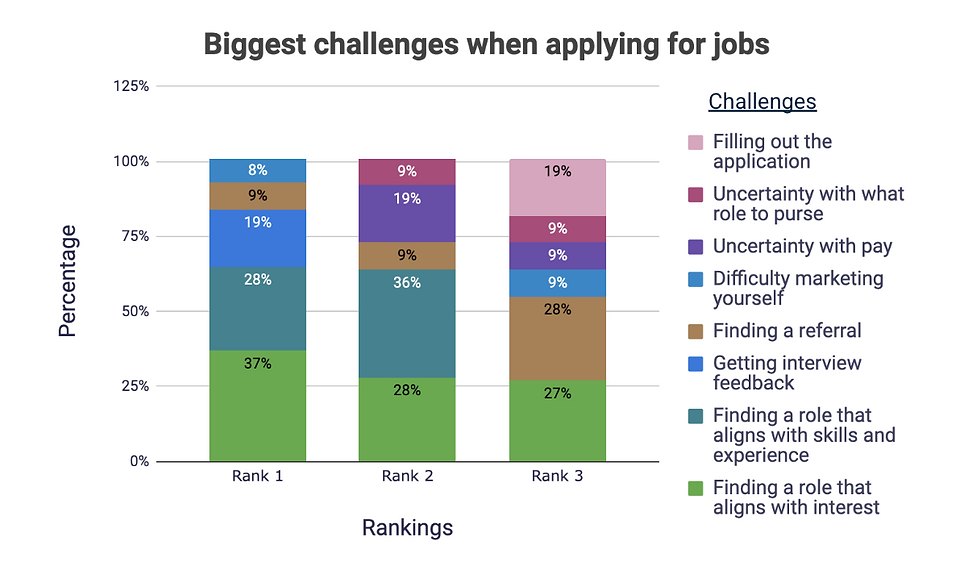
The survey results indicate that the biggest challenges users face when applying for jobs center around finding roles that align with their interests and experience levels. ‘Finding a role that aligns with interest’ was most frequently ranked as the top challenge (37%), followed closely by ‘Finding a role that aligns with skills and experience’ (28%). Other recurring pain points included obtaining interview feedback, uncertainty around pay and career direction, difficulty marketing oneself, and securing referrals. Overall, the findings suggest that job seekers struggle most with identifying opportunities that feel both personally meaningful and professionally aligned.
Key Finding #2
Results of asking participants to rank the top 3 features they would like to see on the platform.
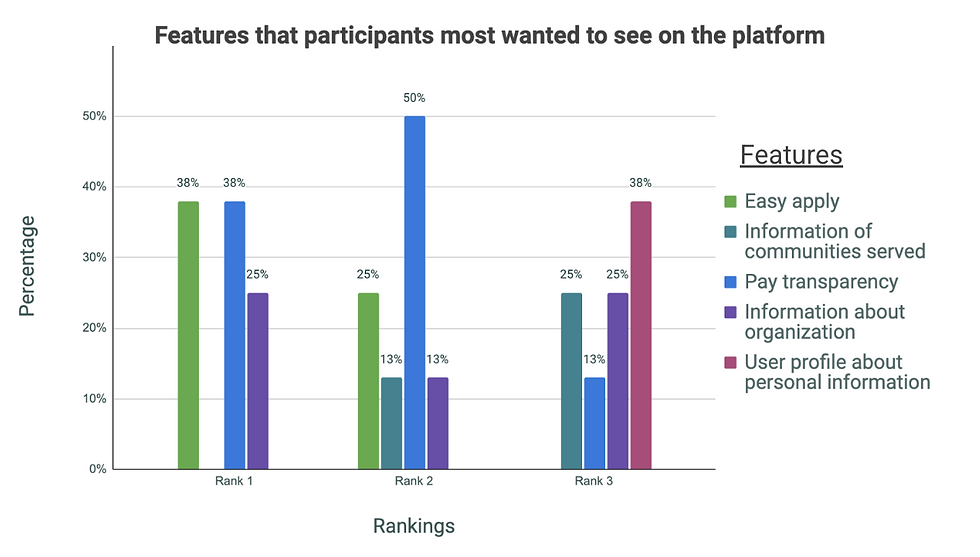
The survey findings revealed that participants most valued features that increased efficiency, transparency, and personalization within the job search experience. ‘Easy apply’ and ‘Pay transparency’ were most frequently ranked as the top desired features (38% each), highlighting users’ desire for a streamlined application process and clearer compensation information. Pay transparency was also commonly ranked second (50%) reinforcing its importance across participants. Additional desired features included access to information about organizations and the communities they serve, as well as personalized user profiles that could better support tailored job recommendations and application experiences.
Key Finding #3
Results of asking participants to select the technical skills that they have.

Most commonly reported skills included Data Analysis (24%), Survey Design (19%) and Programming (14%), highlighting a strong foundation in analytical and research-oriented competencies. Additionally, frequently reported technical skills included GIS, product development, and database management (8% each), reflecting a diverse range of technical expertise among participants. Smaller proportions of respondents also identified experience in impact evaluation, media editing, engineering, and graphic design, suggesting a multidisciplinary skill set across the participant population.
Method 3: Prototype Testing
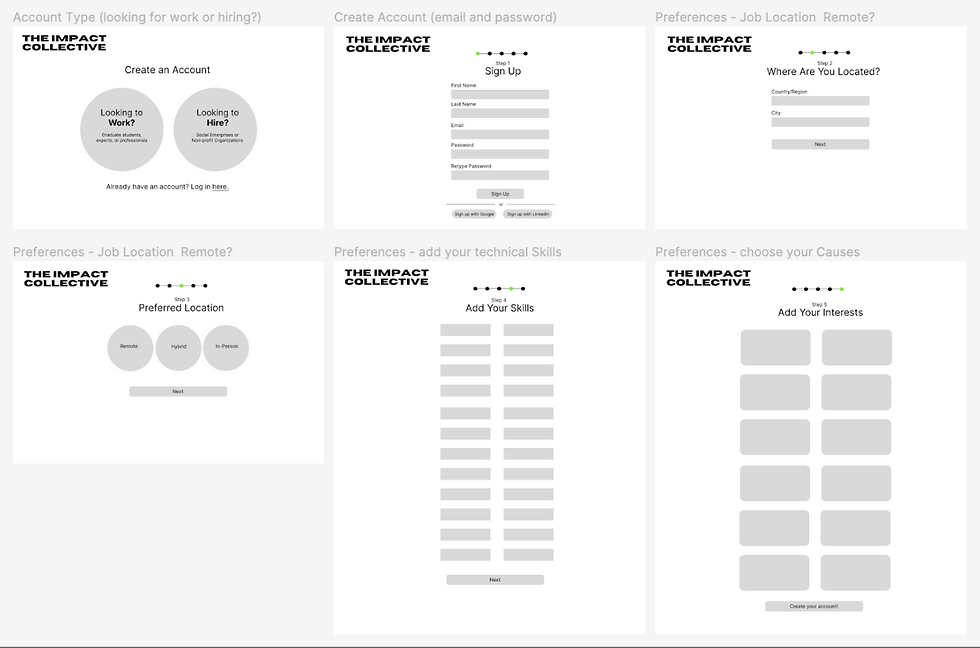
Using the feedback and user needs from our interviews and surveys, we created a low fidelity prototype on the 'sign up process; and 'profile page' to get feedback and visualize the user flow.
Here are a few of the initial prototypes created:
Key Finding #1
In the sign up process prototype, we got feedback to add a search bar to make it more efficient for users to “Select their Skills”. In addition, we added a “Language and Proficiency” section to better understand our users’ skills to help match and suggest specific projects that need specific language requirement(s).
We added search engine for the “add your skills” page and a language proficiency section.


Key Finding #2
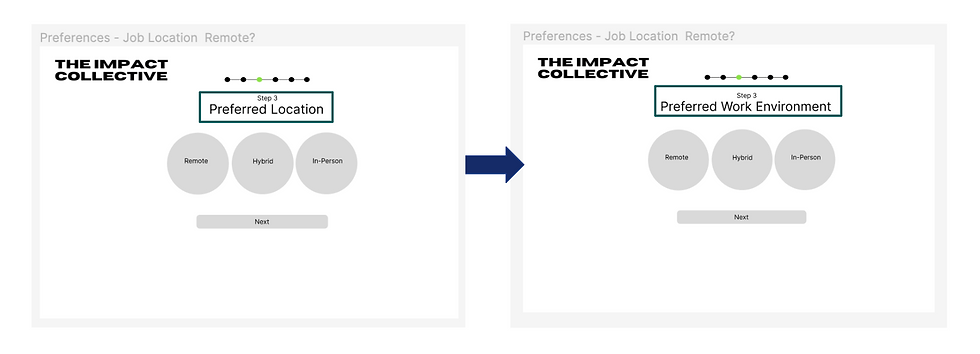
We received feedback that the work preference wording is confusing. To make the webpage more clear, we changed “Preferred Location” to “Preferred Work Environment”.
Key Finding #3
We received feedback from our clients that they did not want the User Profile to be similar to a Linkedin profile. From the surveys, we also received results that users want a way to network on the platform and save their resume & skills for a streamlined application process. We incorporated this feedback to guide our design for the User Profile.

Conclusion and Recommendations
Conclusions
Users want transparency on:
Type of work and its impact
The team and team dynamic
Whether or not work is paid
Engage with tech talent with these skills:
Data analysis
Survey design
Programming
Move away from branding like Linkedin, but still honor user’s needs
Recommendations
Engage with companies/organizations and create profiles with features that display the type of work and team
Enable feature that allows users to choose volunteer or paid work and transparency on how much they can get paid.
These are the most common skills and knowing this will help the Impact Collective to engage with the right clients who need these particular skills
Develop the Impact Collective’s unique branding style, while still allowing users to create user profiles and have the ability to network
Impact
Our clients used our findings to inform and submit their business pitch to the UC Berkeley Big Ideas Competition. Our clients were a top 10 finalist who received funding for their idea!
Guidance for Future Work
Here are the next steps to drive the project forward
Develop the Impact Collective’s unique branding style
Determine the voice, tone, and color palettes
Determine visuals and written material with accessibility in mind
Develop a style guide to ensure consistency
Iterate content strategy/ process and improve
Launch website and conduct usability tests to determine pain points
Redesign content to create a streamlined user experience
Track and analyze content performance
Analyze key performance indicators like traffic engagement and goal completions to measure success of the platform
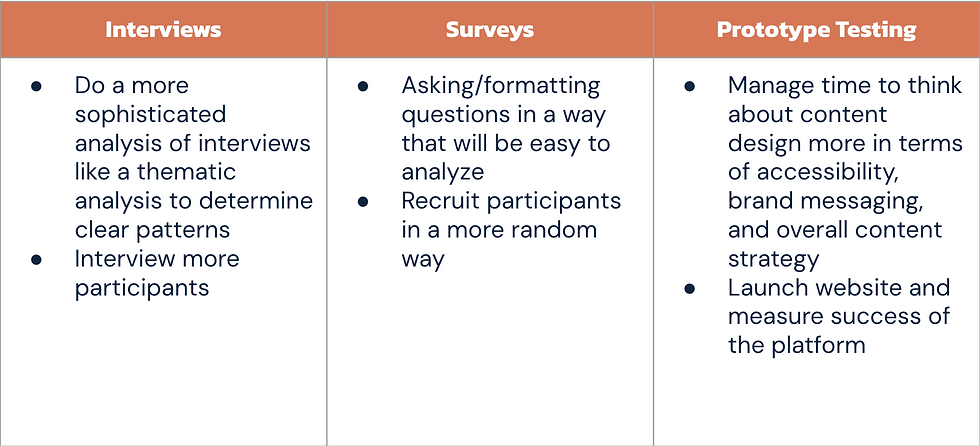
What I learned
What I would do differently