Case Study: Digital Mental Health Study
- Genesis

- 7 days ago
- 4 min read
Updated: 5 days ago

My role: UX Researcher/ UX Research Operations Analyst
Timeline: 1 year
Introduction
The UCLA Depression Grand Challenge (DGC) is a campus initiative to transform understanding of depression and make effective treatments. Research efforts are focused on discovering depression causes and biology to develop targeted treatments. The DGC conducts various studies including the National Digital Mental Health Study (NDMH).

NDMH is a digital sensing study, in collaboration with Apple, to obtain objective health measures, including physical and mental health activity, sleep, and iOS device usage and interaction, and examine these factors in relation to symptoms of depression and anxiety.

Study Overview
Recruit 600 participants to participate in 6 months of data collection, including:
Daily Apple Watch wear
Completing tasks with Apple Health and Research applications
Responding to questionnaires


Study Timeline and Tasks
Participants were assigned daily, biweekly, and periodic tasks (every 8 weeks) to complete on their devices.

To get a better idea of the volume of data collected, here is a visualization of the data that was compiled over a 6 month period.

User Profile
Like the name of the study implies, 600 participants were recruited nationally.
The study recruitment was unique since there was no targeted user profile. Instead, one of the goals was to collect data from a diverse background of participants.
Eligibility factors included:
Current symptoms of depression
Age
Sex
Race
Ethnicity
Height and weight
State of residence

Notice
On account that the study content is highly confidential, I am unable to showcase specific details of my work. However, I'd be happy to walk through my research approach and thought processes.
All information previously stated is publicly available here.
My Role
Due to the high volume of participants enrolled and data collected, I had a nontraditional UX Research role in this study. Instead, I had a hybrid role were I combined responsibilities of a UX Researcher and a UX Research Operations Analyst. I was responsible for instructing participants on how to perform the study tasks and ensuring that participants followed through with tasks until study completion.
Below is a brief summary of my responsibilities:
Onboard

Introduce study goals and tasks
Ensure participants understand how to perform and access study tasks
Troubleshoot

Diagnose technical issues
Provide recommendations for devices
Contact

Contact participants to address compliance
Ensure adherence to study tasks
Apply habit-formation principles
My Research Goals
With my responsibilities laid out, my goals were simple:
Goal 1
Ensure high compliance to study tasks, and retain and improve participant engagement.
Goal 2
Ensure high quality and consistent data collection throughout the study.
Methods
To meet and carry out my study responsibilities and goals, I conducted 3 main methods:
1) Onboarding sessions (With usability-style assessments)
2) Troubleshooting (Monitoring for missing data and diagnosing technical issues)
3) Contacting (Check-in phone calls)
I will review how I executed each method, the challenges I encountered, how I overcame the challenges, and outcomes from each method.
Method 1: Onboard Assessment with Usability-style Testing
Responsibilities
1.5 hour video conference to train participants on study tasks
Guided participants on how to access tasks on devices, when to complete tasks, and how to enable device settings
Observed participants perform tasks, determined user pain points, and provided support for seamless usability
Challenges | Approaches |
|
|
Outcomes
Improved user confidence and adoption, ensuring independent use beyond initial session
Onboarded participants with varying levels of technical experience, enabling participants with varying levels of digital literacy to participate effectively
Reduced friction and cognitive load, reducing early participant drop-off
Refined intake instructions based on recurring participant friction points
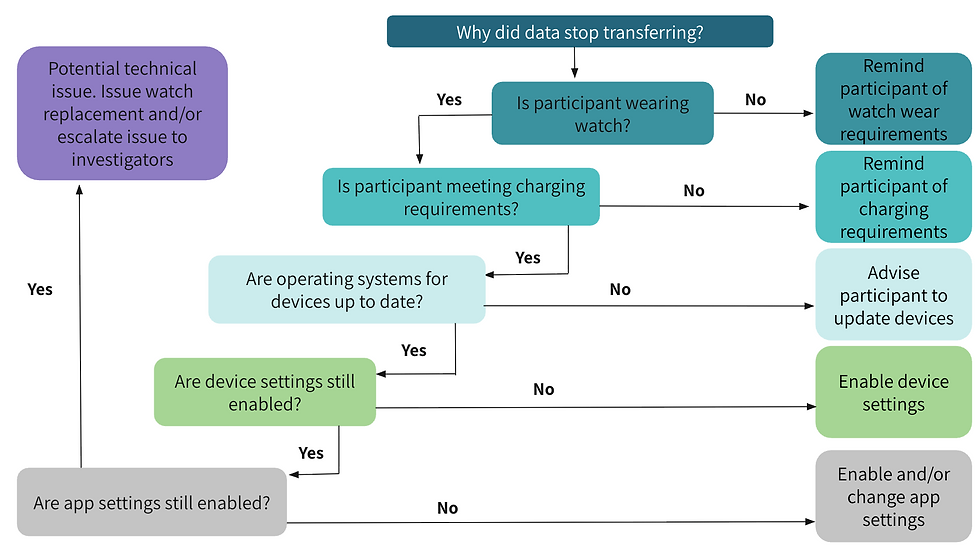
Method 2: Troubleshooting
Responsibilities
Reviewed multiple high volume data streams daily to detect non-compliant participants
Ensured participants continued to complete study tasks to collect as much data as possible
Emailed and/or called participants to remind them of task, or determine if they are experiencing technical issues
Challenges | Approaches |
|
|
Outcomes
Provided timely technical support that prevented participant drop-off and contributed to sustained long-term engagement
Reduced technical barriers proactively, ensuring consistent data capture and minimizing gaps in data collection
Streamlined troubleshooting approaches based on recurring technical issues, enabling faster resolution times across participants
Method 3: Contacting
Responsibilities
Brief phone call every 8 weeks to ask participants about their experience in the study
Opportunity to answer questions, discuss study progress, and collect feedback
Challenges | Approaches |
|
|

Outcomes
Created a sense of accountability and support through personalized communication, reinforcing participant’s commitment to the study
Mitigated missing or delayed data collection by implementing targeted strategies and reminders
Surfaced recurring usability challenges to investigators, informing product and research developments to keep users engaged
Sustained high compliance by combining behavioral insights with structured follow-up strategies to support participant adherence
Study Summary
Overall the study had satisfactory retention rates and positive participant feedback! Below is a summary of what I learned from the study and what I would do differently for future projects.
What I learned

What I would do differently

